Adventures in Identifying Books
One of the odd things about this project is that when we describe the Wosk–McDonald Aldine Collection at SFU, we always say “roughly 120 books.” It seems like it should be simple enough to say exactly how many books there are – but it’s not. There are several reasons for that.
The most obvious reason is that SFU Library continues to add volumes to the collection – a dozen or so in the past couple of years. The reason I’m being cagey about even that small number is that not all of them are catalogued and described yet… which is kind of a microcosm of the larger problem with counting these books.
The majority of our Aldine Collection came to SFU in 1995 from collectors Hugh and Jerry McDonald, who can built their collection from many different sources over many years. Along with the books that came to SFU was a stack of collectors’ notes gathered with the individual book purchases along the way. Those notes, along with the physical books themselves, and various other librarianship aids, went into the original cataloguing of the books as part of SFU Library. 1995 was, of course, a still-embryonic time in the computerization of library catalogues; the vast digital resources that we take for granted now – WorldCat, for instance – weren’t yet available. The cataloguers at SFU in the 1990s did their best with the information at hand.
Complicating this somewhat – at least from our perspective – is the library practice of assigning call numbers to editions; multiple copies of the same edition simply two locations for the same record; similarly “vol 1” and “vol 2.” This is somewhat underpowered for our purposes: different copies, even different volumes in the Aldine collection can be wildly different, given the 500-year history of these books.
Confounding and complicating all of that is that in some cases, the books just aren’t what they say they are. Aldus was fastidious in the formal documentation of provenance in the colophon for each book – but his heirs sometimes passed off a later second edition as the original, with the original colophon unchanged. So do we actually have “c1” and “c2” of the 1501 Juvenal, or is “c2” a poorly marked second edition masquerading as a first edition? It’s hard to tell without more serious bibliographic (and scholarly) analysis, the result of which might be a date that contradicts what the colophon says, what the collectors’ notes say, what the library catalogue says, and even what previous scholars have said about the book.
The process of bringing this collection online here has the effect of forcing us to grapple with these issues. There are at least four sets of information in play: the physical books themselves, the digitized version of the collection, the library catalogue (which may or may not agree with WorldCat in any one instance), and our own hand-gathered bibliographic data. Up to this point, the fact that these four sources may be slightly out of sync with one another hasn’t posed a serious problem. But as we ready our “digitally remediated collection” for public consumption, we do feel the pressure to get this right – to straightforwardly correct and clarify the identity of these books where possible, and to at least document the outstanding issues where it is not possible.
How hard can it be to identify a book?
Much of our data comes from our Library catalogue, and much of that data comes from OCLC/WorldCat, which is the big unified catalogue which libraries can use to download a ‘canonical’ set of data about a book.
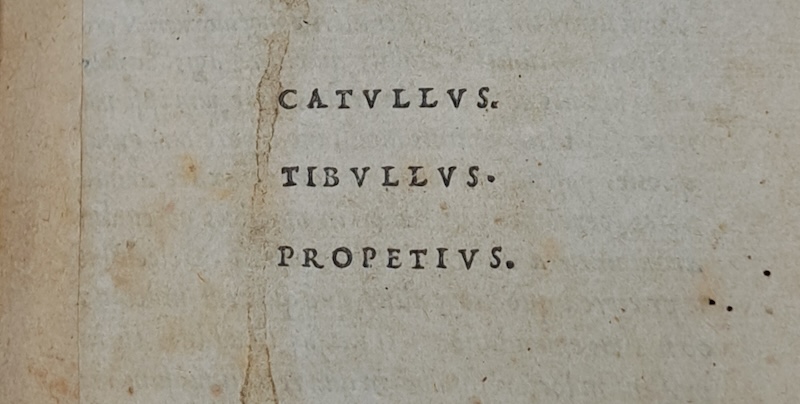
WorldCat works pretty well in general, I think, but with editions from the early 16th century, it gets complicated. The reasons are pretty straightforward: first off, that these books pre-date cataloguing standards; it’s not surprising that cataloguing standards struggle a bit to do the right thing with them. What’s the title? Is it what’s printed on the title page? In many of our earlier editions (from the 1490s and early 1500s) the title page is more like a table of contents than a title as we now know them. There’s an interesting bit of history about titles… the ancient Greeks seem to have been better at giving their books nice short tidy titles than the Romans did, so where Greek classics often have something that we would recognize as a title (Poetics or Oedipus the King), Roman classics often don’t, so you end up with books where the author’s name is clear, but the title is just Opera (“Works”), or Episolae ("Letters), generic terms for what they contain. Or sometimes, the title of the book is just the author’s name: Horace or, Catullus. Tibullus. Propertius.[1]
When was the book published? Here, the Aldine press is helpful, because there’s a pretty standard-format colophon at the back of every book, something along the lines of:
Venetiis · In aedibus Aldi · Mense Januario 1502.
Except sometimes they lie. Bibliographic scholars like Randall McLeod[2] like to do the detective work to prove that a book was on the press earlier or later than it says, which is perhaps not terribly surprising, as the press probably had multiple editions going simultaneously, and it might have taken weeks or months to finish an edition. But sometimes, they totally lie. A good example here is the edition of Juvenal that is supposedly from 1501. The colophon says it’s 1501. But various scholars have pointed out that it contains features that couldn’t have been printed in 1501: the version of the anchor-and-dolphin device, for instance, and so they date the book at 1512, or 1515, or even 1517, based on these bibliographic clues. Why does the colophon say 1501, then? Well, it’s a second edition, probably drawn largely uncorrected from the original 1501 edition (which does not have an anchor-and-dolphin device at all), and so they might have simply represented it as ‘the same as’ the 1501. And it might be the case that, if this book was printed after Aldus’ death in 1515, the old man’s famous care with details was, well, sidestepped.
The more cogent point, though, is that it wasn’t some terrible breach of industry protocol to do such a thing in the early 16th century, because industry protocols like that didn’t exist yet. We can scorn them for it today, but at the time, it may have looked like a reasonable marketing decision: It’s the same as the 1501 edition, so let’s call it the 1501 edition. But it makes identifying the book today a bit of a challenge.
Publishers vs binders
The other serious issue with the identity of these books comes with their binding – and re-binding, God-knows how many times over the past five centuries. We know that the Aldine press didn’t bind their books in house: they sold them folded and gathered, but as a buyer you’d get it bound elsewhere. And, over 500 year, these books have been bound and re-bound multiple times. So there are all sorts of variations in them.
It’s not just that the covers are different. When a book is bound or re-bound, decisions get made about what to include (as well as how much of the page gets chopped off in un-binding them in the first place). The most intense example of this in our collection is our 1505 Aesop – Aesop’s Fables, in both Greek and Latin translation, plus a collection of other texts that Aldus thought made sense to include. Except the copy we have, re-bound in (I think) the 18th century with the world’s ugliest marbled end-papers, contains none of Aesop, in Greek nor in Latin. Rather, our copy consists entirely of one of Aldus’ additional included texts: a collection of proverbs from the Suda.
So in one sense, this book is the Aldine Aesop of 1505. And in another sense, it totally isn’t. What to do with that? If we say that it isn’t the Aesop (which would be a reasonable claim), then what is this book? There isn’t a simple answer to that question. But there are multiple ways to think about answering it.
To say that it is the 1505 Aldine Aesop, albeit a partial/fragmentary copy, is perhaps the simplest answer: this identifies the edition, a work that came off the Aldine presses at a particular month in 1505, representing an intentional effort on the part of the publisher to produce this book. We can take into consideration the fact that over time, this copy of the book has become diminished, so that only a portion remains, even if we cannot say with any confidence when and why exactly that happened.
On the other hand, to say that it is an edition of the Proverbs from the Suda, as printed by the Aldine press, is in some senses more accurate: this is, textually, what is in this copy. But the identity of the book is troubled by this, because Proverbs from the Suda is not a title the Aldine press represented, except as an add-on text. Knowing that it is this text does not help us locate this book in its published history – or, to the extent that we can attempt this, it is indirect and even somewhat backwards.
The identity of the book is not the same as its content. Nor is the identity of the book quite the same as its edition. The edition of the book is not even identical across existing copies of the book – this is something that is more apparent with the passage of time. And this fact is difficult to grasp, given library cataloguing standards, which typically privilege the edition as a trusted fact, leaving multiple copies and other variations to be a secondary bit of information.
What is a book?
More recent books – say, the 1970 first edition of Toni Morrison’s The Bluest Eye – can be represented reasonably well given standard industry and institutional practices. A sizeable public library might have multiple copies of The Bluest Eye – multiple copies of this first edition, even. They may not be perfectly identical: one might be signed; another might have dog-ears and pencil notes. But for the purposes of the public library, these copies will serve as interchangeable versions of the ‘same’ book.
But for books from the 15th and 16th centuries, this falls apart. These old books have lived long, sometimes complex lives. They too may feature autographs and notes and the signs of wear – for which they may be of particular interest to different scholars. But on a more gross level, the have probably been re-bound, and in the process may have lost (or even gained) parts. Sometime this might be an almost existential change – as in the case of our 1505 Aesop, which contains no Aesop. A point of comparison might be our 1502 Aldine edition of Ovid’s Metamorphoses, which we discovered is missing about 125 pages of an index that this edition featured in the front pages of the book. Our copy has a title page and preface, but then goes straight to Ovid’s text. When comparing our copy to other digitized copies on the Internet (thanks, IIIF-enabled collections), we discovered that ours is more than a hundred pages shorter. Is it the same book? Yes. And no.
Should we call the 1501 edition of Juvenal – the one that apparently lies in its colophon – the 1501 edition? Or should we call it the 1512 edition, as it is represented in our own library catalog? Or should it be the 1517 edition, as per David Shaw’s scholarship? A look at two digital facsimiles available through the Internet Archive, sheds some light on the problem. One, from the Biblioteca Nazionale Centrale di Firenze, is simply labeled as “1501.” Another, from the Fondazione Giorgio Cini in Venice, carries a qualifier: “1501 [i.e. after 1508].” Both copies feature the Aldine anchor-and-dolphin device that is the first clue that this book is from significantly later than 1501.
What is true? Many things are true, and some of those things have implications for the identify of these books. There is a kind of truth that library catalogues trade in – based conventionally on information such as the colophon in the book itself – that is designed to make books findable by borrowers and researchers. A second kind of truth is traded by scholars and bibliographers, who can make claims about the book based on close examination of bibliographic evidence – such as the particular version of the Aldine device as printed in the book, or the blind impressions left on the page in the printing process. We might call the second kind of truth “interpretive,” although that might suggest it is less factual. We might also call the first kind of truth “conventional” although this too may serve to undermine its authority.
This is not actually a contest. Both accounts of the book, and both kinds of claims to truth are useful; as knowledgable readers we learn how to contextualize and understand these claims, and what kinds of service they can be put to. But the face contradition of some of these claims can be jarring. When was the book published? What is the title of this book? What is this book?
This one is fun because our copy of it has a major typo on the title page: “Catullus. Tibellus. Propetius.” Whoever managed to misspell the Propertius on the title page probably, well, regretted that. Interestingly, if we look at the dozen or so digitized copies out on the Internet, about half of them feature this typo, and half have the properly spelled name… I imagine they caught it halfway through the press run and fixed it on the fly. But hundreds of botched copies made it into circulation anyway. ↩︎
One of Randall McLeod’s tour de force talks is on YouTube: “The Birth of Italics” (Rare Book School Lecture #604, 1 August 2016). 2016. https://www.youtube.com/watch?v=FTtYDgWSte4&feature=youtu.be&a. ↩︎