At ‘By the Book’ 2026 in Mainz
John travelled to Europe in June 2026, first visiting Publishing Studies colleagues in Lithuania, and then attending the key conference in Publishing studies, By the Book, in heat-struck Mainz, Germany, June 24 & 25.
The following is a lightly edited version of the presentation John delivered there. The intent here was to represent the Aldine project to the pub-studies community, and also to talk about what a digital book-history project looks like coming from Publishing as a discipline – as opposed to English or History.
Remediating the Aldine Press: A Study in Prototyping
John W Maxwell & Alessandra Bordini
Simon Fraser University, Vancouver
June 24, 2026
Hi, everyone, I’m honoured to be here from Vancouver Canada, which is the traditional and unceded territories of the Musqueam, Squamish, Tsleil-waututh people.
The perspective I’m bringing is Canadian: I like to foreground independent publishers and booksellers, and scholarly communication in the “scholar-led” mode. My research has for many years been about digital publishing – technologies and cultural impacts. Recently, though, I’ve returned to my roots (as it were) as an amateur historian. And as the world burns, I’ve been paying more attention to the 16th century. I want to tell you about a research project we’ve been working on with my absent co-presenter, Alessandra Bordini: the Digital remediation of our university’s Aldine collection: 130+ books from 15th and 16th-century Venice.
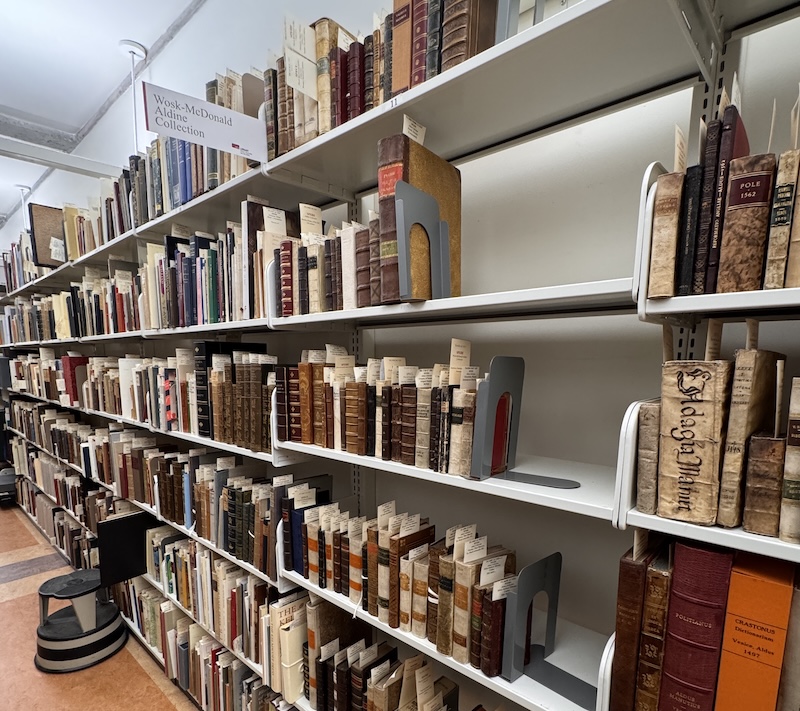
Over the past ten years, SFU Library has digitized them all – full page images of entire books. We’ve been building this as an online resource to showcase, to contextualize, to teach… for audiences beyond the usual book historians.
We have been talking about it as a “remediation” of the collection. But also in a sense, a remediation of the Aldine press itself.Rendering these early printed books as digital artifacts, and adding new layers of digital content and context – description and metadata – around them. Which is to say it is a new publication based on old publications.
A prototype is a conjecture
In thinking this through, we are informed by an idea from the Digital Humanities: Prototyping as a research methodology – in which we pursue our inquiry by creating things. By transforming the ideas in our heads into artifacts that can be shared, examined, and assessed.
To develop a prototype is to make a conjecture about the realization an idea, in a context, for a particular audience – which provides a means to evaluate that conjecture. There is a whole literature around prototyping in the Digital Humanities:[1] how prototypes make arguments; different kinds of prototyping; asking what prototypes lead to. But in thinking about prototyping, we came to an important idea:
Publishing is prototyping
Prototyping, as a mode of inquiry, of learning, is what publishers do. It’s what publishers have always done.
You have an idea – perhaps expressed as a piece of writing. But it needs to be instantiated in the real world. It needs to be given form. It needs to become separate from its creator. In the design process, we make conjectures about what will work: about how we embody and elaborate aspects of the work so that they resonate with an audience that we imagine. The developed work – the publication – and that imagined audience are two halves of the whole. A publisher must conceive of both. The publication and the public.
Then, in creation and development and sharing with others, that conjecture can be tested in its context: Does the form of the work succeed in attracting and engaging an audience? And is that audience the one that we imagined? Is the intended message received? Appreciated?
In doing thia, we learn something. And that learning helps us to make the next publication we undertake. Iteration. It’s not just one; it keeps going.
The implication, for Publishing Studies, I think, is that prototyping is a valid research methodology. It is a serious method of conducting inquiry about the world. It is a method that publishers have used for at least five centuries. In this sense, publishing is a research enterprise. And conversely, much of the Digital Humanities – to the extent that it is concerned with making things – is a kind of publishing.
Aldus’ Prototypes 1495–1515
So that extends our ideas of remediation and prototyping, back well before the Digital Humanities. Indeed they are rooted in a centuries-old printing and publishing tradition.
The prototypes – the conjectures – that Aldus Manutius and his contemporaries made are fairly obvious to us now. We may take these forms for granted today, but a reading of the Aldine Press’ late 15th- and early 16th-C. prototypes is instructive.
What were some of these conjectures, that were then embodied, and tested in a real-world context? Let’s look at some examples:
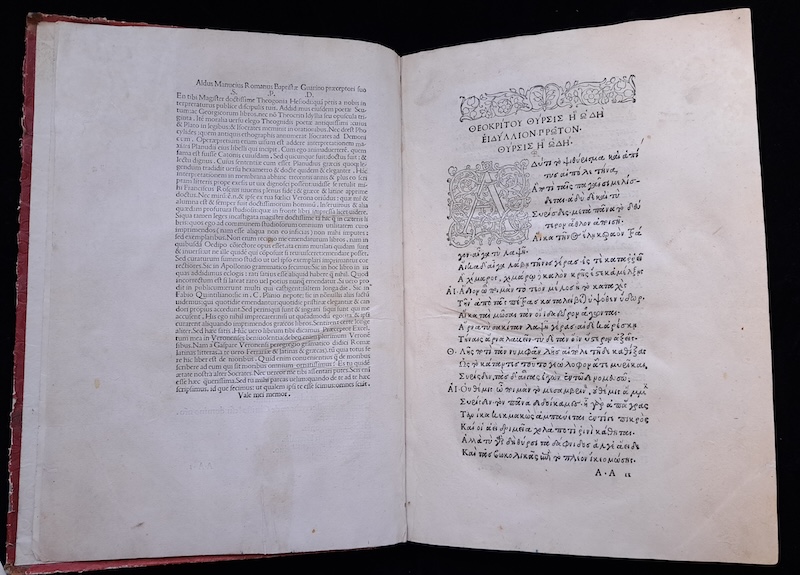
To begin. Aldus thought that Greek literature in print would make a difference to the world.
And he thought that printing many copies of things would open up the closed world of manuscript circulation.
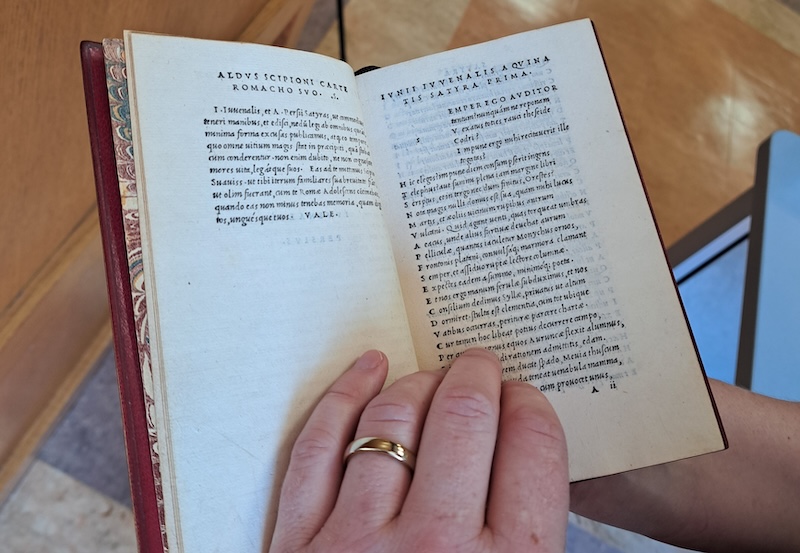
He thought that packaging the classics in small, stylish, portable editions with minimal commentary would inspire people to read differently. Or perhaps, to ‘read different’ as those Apple advertisements used to say
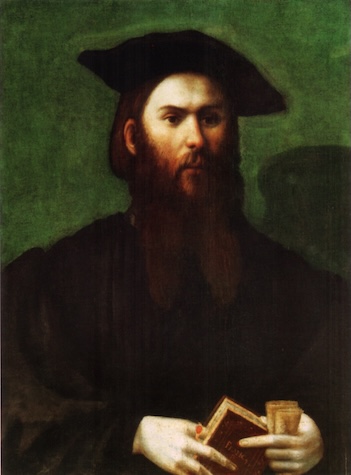
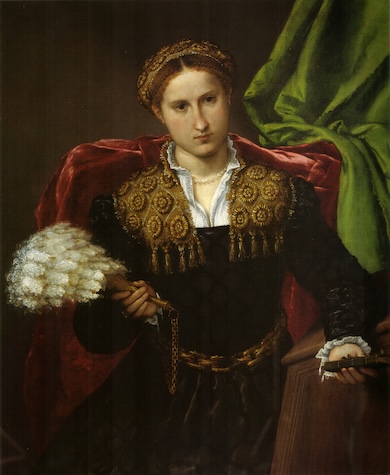
Here are two Renaissance portraits: the first, attributed to the Renaissance painter Parmigianino (1526), likely a priest, holding an elegantly bound copy of Petrarch. (It’s hard to see in the picture, but the back cover of the little book carries the initials of the author FRANC/P)
The second, by Lorenzo Lotto, features the noblewoman Laura di Pola. Her clothes and the ostrich feather an indication of her high social standing; the small book in her hand, in all likelihood a small Aldine edition to be read for pleasure and displayed as a marker of status.[2]
These are not just your mother’s breviaries.
And Aldus thought he could reach an audience – a market – large enough to make the mass production of his books sustainable.
Those are the big obvious conjectures. But in our work looking closely at our collection of Aldines, we see evidence that prototyping is going on at a finer-detail level continually.
One of Aldus’ most celebrated achievements, the italic type. Punchcutter Francesco Griffo’s innovation was modeled on the chancery handwriting of Renaissance Italy.
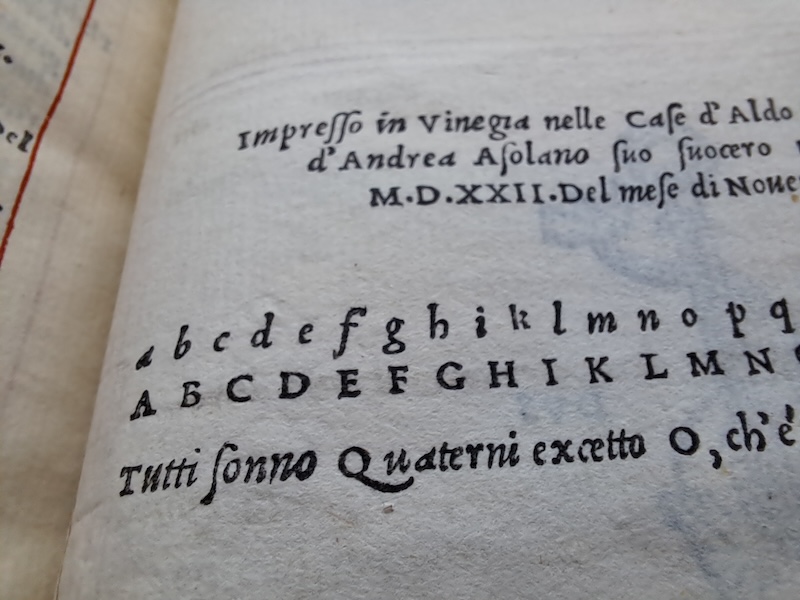
The italic was was a work in progress… first appearing in the Letters of St. Catherine (1500).[3] Two versions exist:
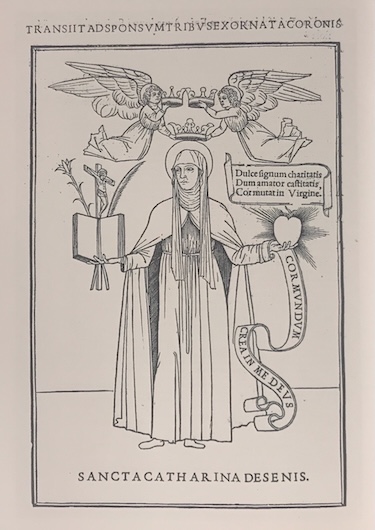
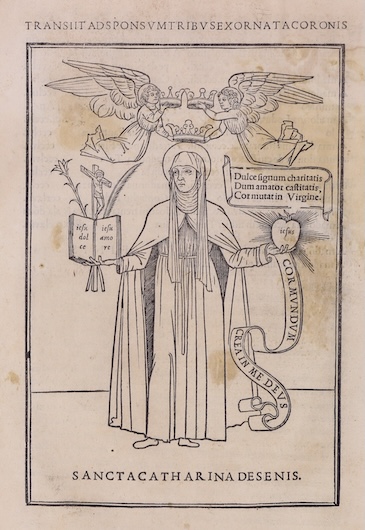
And the following year as an entire series of books – octavos, set in italics.
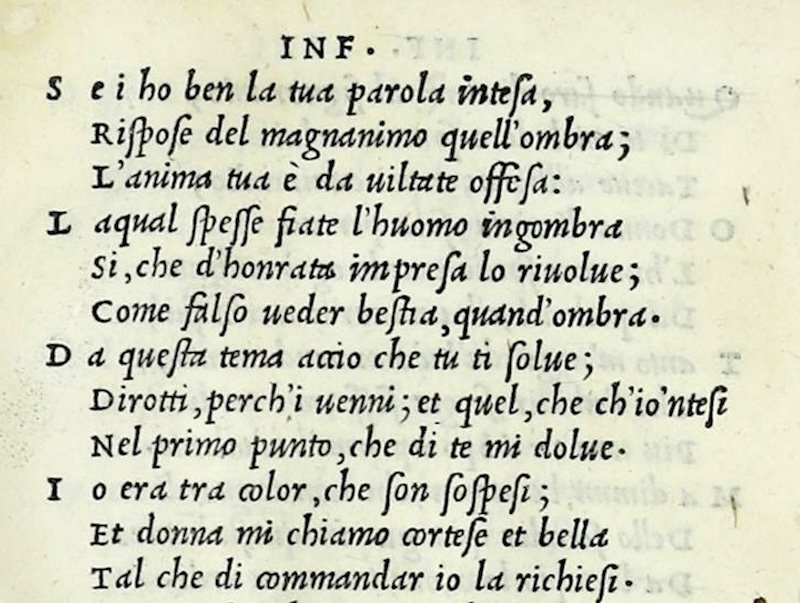
For instance, in the 1502 edition of Dante in which editor Pietro Bembo introduced a new standard for punctuation and orthography – a conjecture that they could make the vernacular more readable for a new audience.
Aldus also prototyped navigational features: page numbering, indexes and tables of contents, and so on.
Here’s Perotti’s Cornucopia (first Aldine edition was 1499, THIS one is the 1513 edition, which we have at SFU.
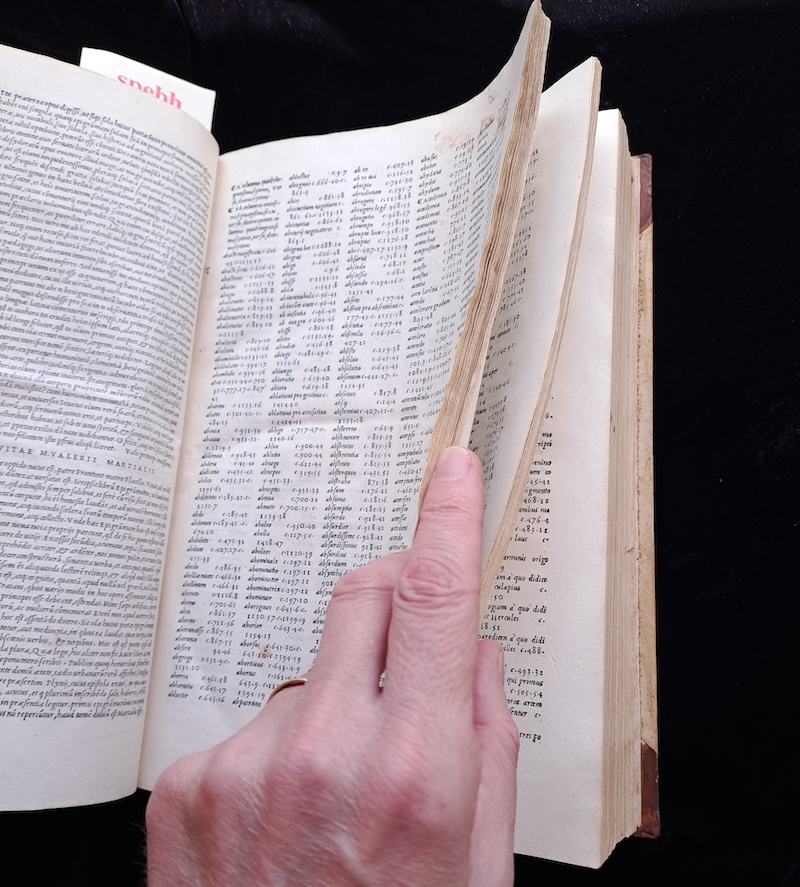
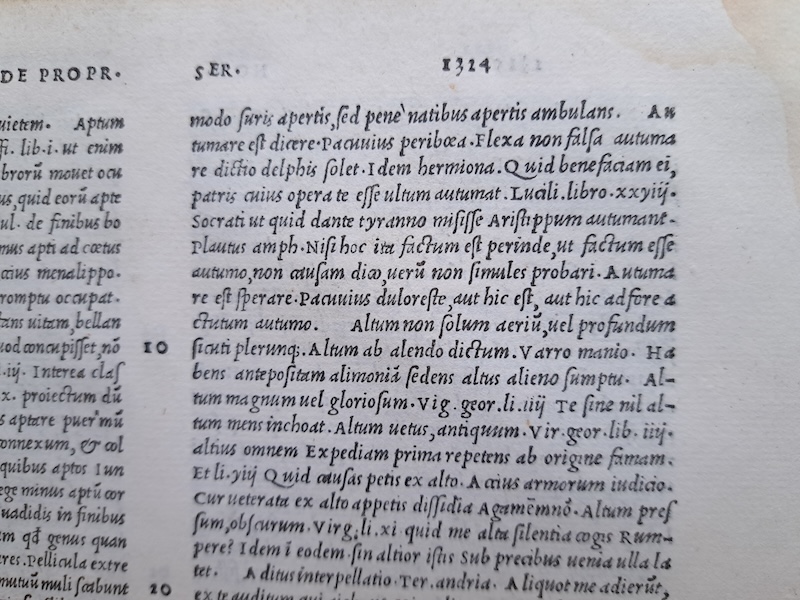
One of the most extraordinary indexes ever created, targeting not only individual column numbers, but to line numbers within that.
Now, the experimental & iterative nature of prototyping reminds us that with the successes were also setbacks and dead ends: unfulfilled ambitions and unrealized projects.
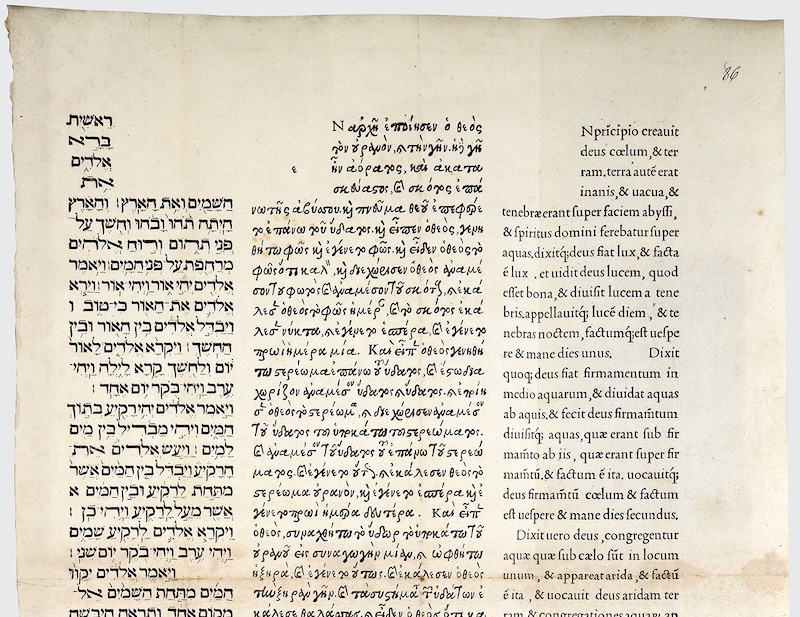
One of them was Aldus’s ambitious plan to publish a polyglot Bible presenting the Hebrew, Greek, and Latin texts side by side, in parallel columns. Famously, the project never came to fruition, but a surviving trial leaf preserved in the Bibliothèque nationale de France demonstrates that the work had advanced from the stage of conceptualization to prototyping.
Failure is a constant companion… if you read the Prefaces that Aldus wrote in his editions, a recurring theme is frustration: with corrections, with labour, with the overall chaos of the printing shop.
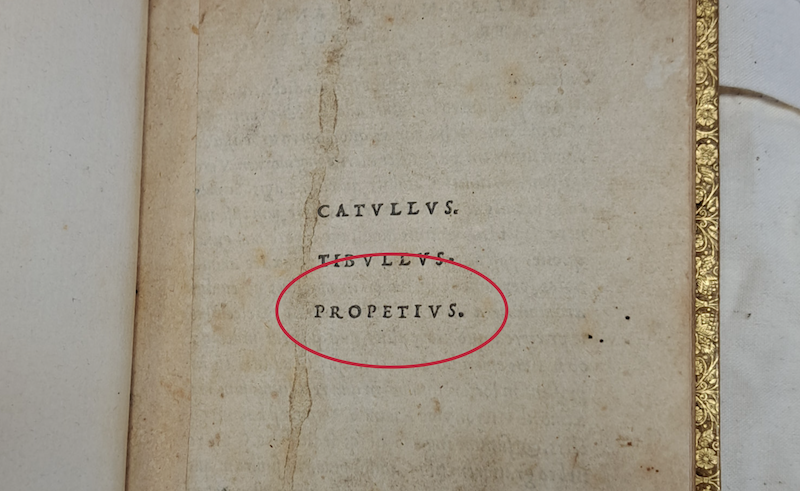
One of my favourites: Propertius. This rather embarrassing error was apparently corrected on the press part-way through the run, as there are as many copies out there today with the error as those with the name spelled correctly.
Remediating Aldus
So view Aldus’s editions as prototypes, themselves remediations in dialogue with past traditions and in specific cultural, economic, and social contexts… all in flux and shaping one another in complex ways.
And we too are making prototypes. Every design decision encodes a conjecture: like, layout and typography things, data display and so on…
Some of them we recognize as good ideas or bad ideas pretty quickly. Some of the decisions we won’t be able to judge for years probably… To see if we’ve been able to gather a new audience – like Aldus tried to do… and to change how people look at these books – like Aldus tried to do.
Remediating our Aldine Collection is about opening up to broader audiences. Not just the six book historians who have ever visited the physical collection.
We invite you to have a look at our remediation project – our prototyping – in progress.
Prototyping in Publishing Education
Now, to bring this back to the themes of the By the Book conference. If we look at the field – Publishing Studies, at the graduate and undergraduate level – I know that many of you are having your students make things.
It could be something like Ooligan Press at Portland State, which produces a whole line of literary titles. Similar but different at Merchiston Publishing at Edinburgh Napier.
Could be more like the way we’ve done it at Simon Fraser University, where our students create hypothetical publishers with hypothetical frontlists, and creating believable titles and catalogues – and presenting to sales reps. And a dozen different variations on that basic idea that people studying publishing should create publications of one kind or another.
That’s a thing that a lot of us do… perhaps to the point of that being native to Publishing Studies. I want to try to raise this up not just a thing that most of us do, to treat this as a research process; to recognize it as a methodology that has really deep roots – back to Aldus and before – in our own field of study.
A sampling of the literature on prototyping in the humanities:
Bath, Jon, Alyssa Arbuckle, Constance Crompton, Alex Christie, and Ray Siemens. 2018. “Futures of the Book.” In The Routledge Companion to Media Studies and Digital Humanities, edited by Jentery Sayers. Routledge. https://doi.org/10.4324/9781315730479-35.
El Khatib, Randa, David Joseph Wrisley, Shady Elbassuoni, Mohamad Jaber, and Julia El Zini. 2019. “Prototyping Across the Disciplines.” Digital Studies/Le Champ Numérique 8 (1): 10. https://doi.org/10.16995/dscn.282.
Galey, Alan, and Stan Ruecker. 2010. “How a Prototype Argues.” Literary and Linguistic Computing 25 (4): 405–24. https://doi.org/10.1093/llc/fqq021.
Ruecker, Stan. 2015. “A Brief Taxonomy of Prototypes for the Digital Humanities.” Scholarly and Research Communication 6 (2). https://doi.org/10.22230/src.2015v6n2a222.
Saklofske, Jon and INKE Research Group. 2016. “Digital Theoria, Poiesis, and Praxis: Activating Humanities Research and Communication through Open Social Scholarship Platform Design.” Scholarly and Research Communication 7 (2/3): 2/3. https://doi.org/10.22230/src.2016v7n2/3a252. ↩︎
See Sergio Momesso 2016. in Aldo Manuzio: Renaissance in Venice. Beltramini, Guido, and Davide Gasparotto, eds. Gallerie dell’Accademia di Venezia. Marsilio Editori. p. 351. ↩︎
See Davies, Martin. 1999. Aldus Manutius: Printer and Publisher of Renaissance Venice. With MRTS Online. Tempe, Ariz.: Arizona Center for Medieval and Renaissance Studies. The version without italic type is a relatively recent discovery in 2008. ↩︎