Doing Digital Scholarship Today
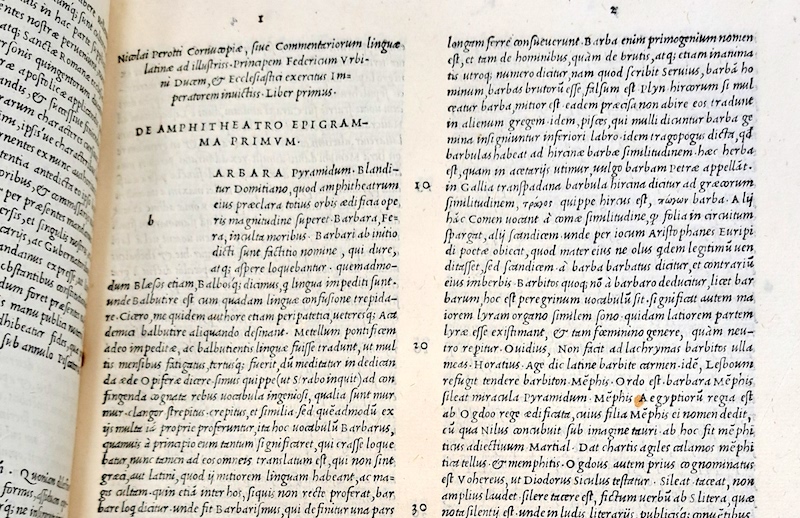
This past winter we’ve spent a lot of time working on the scholarly underpinnings of this project: gathering and reading the literature on Aldus Manutius, on early printing, and on the Italian Renaissance more generally. We have a rich Zotero library together, and have been really digging the joys of scholarly pursuit: following references one after the other, and taking the path where they lead.
It’s easy enough to think of 2025 as a horrific year: so much awful stuff in the news every single day. But it is also, it’s worth saying, a golden age for scholarship; the sheer volume of stuff that’s available on tap, if you merely do a bit of digging, is astonishing. More than astonishing, really, and it deserves to be praised in our time. Because the dream of online and open-access publishing has born such fruit; the digitization of resources is now a giant, sprawling, worldwide movement; and the work of librarians, archivists, and digital scholars to index things and link them all together is incredible.
A case in point is the bibliographic record in and around the Aldine Press. A good chunk of contemporary scholarship in this area dates to the 1990s: recent enough to be “current” but at the same time, born in a different era, at least in terms of the accessible scholarly record. SFU’s Wosk-McDonald Collection was originally acquired in 1995; in those days, if you wanted to look at original Aldine editions, you’d have to travel, physically, to a Special Collections Library like ours and make an appointment to look at the books. You’d take your time to do so, and perhaps you’d have the opportunity to snap a few photos for future reference.
To even find out where Collections like ours exist in the world, you’d consult the literature, or ask a knowledgeable person (assuming you had one handy). And you’d easily enough find out about the Ryland Library collection at Manchester; the Ahmanson-Murphy collection (recently catalogued in the 90s!) at UCLA; and the collection at the Harry Ransom Centre at UTAustin. And of course you’d probably figure out that substantial collections exist in Italy (at the Marciana in Venice!) and elsewhere in Europe. But it would be harder to get beyond those. Even the scholarly literature might present challenges: you could sift through Abstract databases and indexes, looking for keywords like “Aldus.” You might stumble upon gems that are the collected volumes of essays, like Zeidberg & Superbi’s Aldus Manutius and Renaissance Culture: Essays in Memory of Franklin D. Murphy (Leo S. Olschki, 1998). You’d consult Renouard’s 1834 bibliography (in French!).
But today, omigosh, what riches we have at our fingertips. To say nothing of Google,[1] we now have Integrated Library Systems that point to resources both within and outside local collections. We have thousands upon thousands of online and open-access publications[2] at our fingertips, with a standard DOI system that allows them to float effortlessly through catalogues and databases of all sorts. Multi-lingual scholarship? Not a huge obstacle, given the integration of machine-translation into our basic web and desktop tools; we’ve been able to include French, German, and Italian scholarship in our research in ways that would have required so much more a generation ago.[3] And, we have master indexes like the Incunabula Short Title Catalogue (ISTC), the Universal Short Title Catalogue (USTC), and Edit16 showing library holdings worldwide; and indeed the existence of hundreds of digitized volumes (Vatican Library! Bayerische Staatsbibliothek! Internet Archive!), linked from these catalogues. In 2025, doing deep research into the Aldine Press is something that can be done from one’s desk with a web browser.
Here’s a neat example: one favourite, oft-repeated fact in Aldine scholarship is that the first ever paged index (that is, where an alphabetical index points you to page numbers in the edition, like we take for granted today) was the Aldine Perottus (Cornucopia) of 1499. You can find this claim in any number of articles, websites, and books, because it had scholarly authority behind it[4], and it was historically pretty cumbersome to disprove, even if you had reason to be skeptical. But in 2025, a quick browse through the ISTC looking at early editions of the Cornucopia shows there were at least eight Italian editions printed before the Aldine one – and clicking through to the digitized copies, one finds almost all of them had paged indexes[5] – going back to Paganini’s editio princeps in 1489. And, intriguingly, some of those editions used Arabic page numbers and some of them used Latin numerals! To be fair to Aldus, his version adds line numbering to the indexed entries, which is a significant innovation. But the old, well-worn ‘fact’ about the origin of the paged index is shown in a matter of minutes to not actually be true, easily demonstrated given the digital resources we enjoy today.
My point is not to call out historical dogmas; rather it is to appreciate the orders-of-magnitude increase in the availability of scholarly resources: primary and secondary, and perhaps even more helpfully in the infrastructural identifiers, indexes, and linked data that tie it all together.
This also raises an interesting parallel: I imagine that humanist scholars at the beginning of the 16th century must have experienced a comparable ‘leveling up’ a that period witnessed their own order-of-magnitude shift in the availability of books, moving from a manuscript-based to a print-based system. From maybe dozens of available books to hundreds or even thousands of available books, over the period of a generation or two, and with that the rise of the infrastructural work of organizing and cataloguing all of it. Ad fontes indeed!
Alas, Google perhaps exemplifies the darkness that shadows this ‘golden’ age: in the classic ‘enshittification’ move, Google’s search results have seemingly degraded in quality and are now infected by ‘AI slop.’ I’ve personally switched to DuckDuckGo, but it’s a worrying trend. ↩︎
The caveat here is that an awful lot of the ‘available’ material isn’t open-access, or is encumbered by big publishers and aggregators such that what is seemingly available on the web is sometimes only readable through our institution’s library and the brittle web of licensing deals that support that. ↩︎
Make no mistake: our machine-translated reading is full of the hermeneutics of suspicion, and I would balk at quoting a machine-translated passage or even making a claim based on it. But when reading for orientation and general sense and scope it is enormously valuable to run a German article through DeepL and see what’s inside. Also worth appreciating that Alessandra is a native Italian speaker! ↩︎
Scholarly authority is, for better or worse, kinda circular: things are authoritative because authors say they are, and while that is technically tautological, it’s not such a vicious cycle in practice because there is a community of scholarly review and critique that holds it to account. But it helps loads when the evidence to support the cycle is readily available, right? ↩︎
Once one printer built the index, a second printer could copy the pagination pretty easily. Typesetting being a line-by-line process, if you were working from a printed copy, it’s unlikely you’d get wildly different pagination. ↩︎